
Chikankari is a style of hand embroidery from Lucknow, the capital of Uttar Pradesh in northern India. The word comes from chikan, generally traced to a Persian word for embroidery, and the craft has been practised in and around Lucknow for centuries — flourishing under the patronage of the Nawabs of Awadh, with roots often traced back to Mughal-era courts. What began as white thread on white muslin has grown into a full vocabulary of stitches worked on cottons, georgettes and silks in every colour.
How Chikankari is made
A genuine Chikankari piece passes through several pairs of hands. The design is first carved into wooden blocks and stamped onto the fabric in a washable dye. Embroiderers then work the stitches by hand over the printed pattern — the slowest step, often taking days or weeks for densely covered pieces. Finally the fabric is washed to remove the printed guidelines, leaving only the raised thread work.
A short glossary of Chikankari stitches
Part of what makes the craft special is that it isn’t one stitch but a family of them. The ones you’ll meet most often:
- Bakhiya (shadow work) — worked from the reverse of sheer fabric so a soft “shadow” of the motif shows through on the front. The signature Chikankari effect on muslin and georgette.
- Phanda — small, tight millet-shaped knots, used for flower centres and grape-like clusters.
- Murri — rice-shaped knotted stitches, slightly longer than phanda; a mark of finer, more time-consuming work.
- Jaali — open trellis-like netting created by pulling warp and weft threads apart with the needle, without cutting the fabric. Good jaali looks almost like lace set into the cloth.
- Tepchi — a simple running stitch used for outlines and light all-over patterning, often the first stitch apprentices learn.
Hand embroidery vs machine imitation
Because Chikankari commands a premium, machine-made imitations are everywhere. A few honest tells: hand work shows small irregularities — no two motifs are perfectly identical; the reverse side shows knots, thread changes and human finishing rather than a mechanically uniform back; and true shadow work only makes sense worked by hand from the reverse. If every motif on a piece is pixel-identical, a machine made it. We cover this in detail in our guide to buying authentic Chikankari online.
Why it matters
A hand-embroidered kurta carries hours of skilled work you can see up close — and it means every piece is subtly one of a kind. It’s also why genuine Chikankari costs more than printed lookalikes, and why it rewards gentle care: washed and stored properly, hand embroidery outlasts fast fashion by years. Our care guide covers the routine.
Ready to see the stitches in person? Browse our hand-embroidered Chikankari kurtas, anarkalis and unstitched suit sets — or start with the full collection.
About the author :
Related posts
Popular products
-
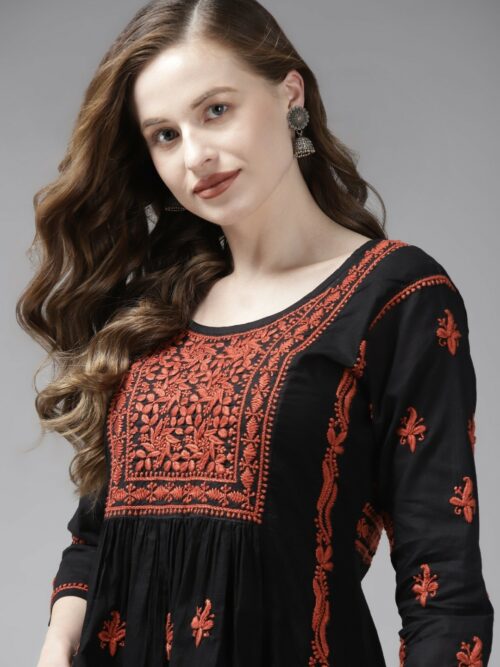 Hand Embroidered New Cotton Lucknowi Chikankari Kurti KKCK31
د.إ180.00
Hand Embroidered New Cotton Lucknowi Chikankari Kurti KKCK31
د.إ180.00 -
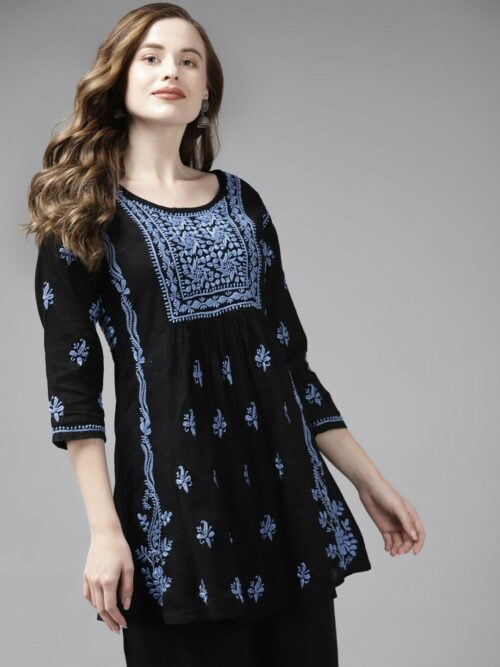 Hand Embroidered Black New Cotton Lucknow Chikankari Kurti KKCK30
د.إ180.00
Hand Embroidered Black New Cotton Lucknow Chikankari Kurti KKCK30
د.إ180.00 -
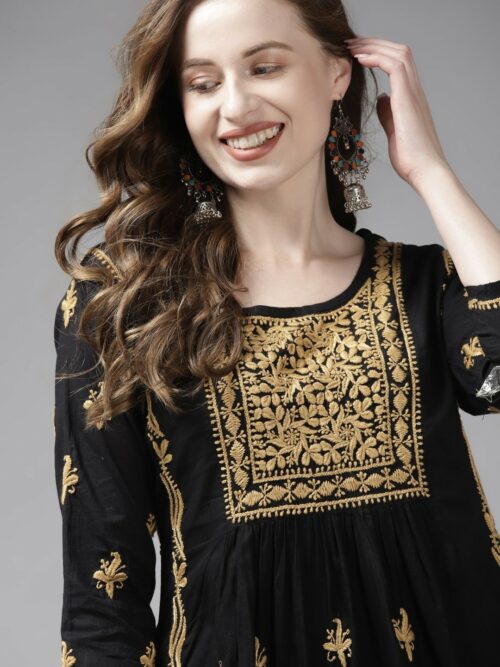 Hand Embroidered Black New Cotton Lucknowi Chikankari Kurti KKCK29
د.إ180.00
Hand Embroidered Black New Cotton Lucknowi Chikankari Kurti KKCK29
د.إ180.00 -
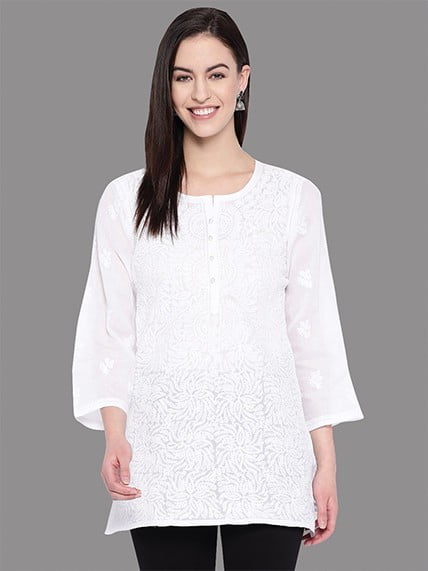 Aykez Hand Embroidered New White Cotton Lucknowi Chikankari Kurti KKCKBS02
د.إ180.00
Aykez Hand Embroidered New White Cotton Lucknowi Chikankari Kurti KKCKBS02
د.إ180.00
